Key safes allow your family members, home carers and the emergency services to quickly enter your home, which particularly helps older people living alone to stay independent.
This key safe box guide explains how safe they really are, where to install them and what families should consider.
Page contents
At a glance
- Key safes can be a safe and practical solution for older people living at home, as long as they are high-quality, securely installed, and used correctly.
- They enable quick access in emergencies.
- The safety of this item depends on choosing police-approved models, installing them discreetly in solid brickwork and managing access codes responsibly.
- Only share the code with people who need it, avoid predictable combinations and review who has access if circumstances change.
What is a key safe?
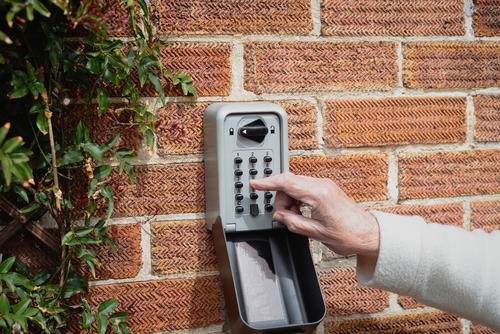
A key safe is a small, lockable box usually fixed to an external wall, that stores a house key.
Access is granted via a code, allowing only the people you trust, such as home carers, family members, or emergency services to enter your home without needing a spare key.
These devices can give you and your family peace of mind as long as it is secure, correctly installed and used appropriately.
A key safe may be particularly useful if you:
- receive regular care visits
- live alone
- are at risk of falls or medical emergencies
- have memory difficulties, such as dementia
Are key safes safe?
A good-quality key safe can provide a secure way for trusted people to access your home when chosen, installed, and used correctly. However, no key safe is completely risk-free, so the model, installation and management of the access code all matter.
A key safe can also be useful if you receive home care, as it lets a care worker enter when you can’t answer the door. The safety of this device depends on three main factors:
1. Quality of key safe
High-quality key safes are:
- Police-approved. Secured by Design (SBD) is the official UK Police initiative supporting products that prevent crime, and these key safes meet its stringent criteria.
- LPS 1175 Certification: Tested against forced entry. Products are physically tested to withstand attacks using specific tools (from simple cutters to power tools) for set durations, simulating real-world threats. This is a widely recognised UK standard for intruder-resistant building components and security products. The Loss Prevention Certification Board (LPCB) issues it.
- Made from reinforced steel.
- Resistant to weather and tampering.
Cheaper models may look similar but often offer little protection.
2. Correct installation
Even the best key safe is vulnerable if it is:
- Installed in a visible location.
- Fixed into weak brick or mortar.
- Poorly secured with incorrect fixings.
3. Safe code management
Security risks increase if:
- The code is shared too widely.
- Codes are never changed.
- Predictable codes are used (e.g. 1234 or birthdays).
If you change your key safe code regularly, tell only a few trusted people and avoid easy-to-guess numbers.
Who should know the code?
Only trusted individuals such as close family members and professional carers. You should change the code regularly.
Is a key safe better than giving carers spare keys?
A key safe can be more practical than giving out spare keys because you can manage access through a code.
Do emergency services use them?
Yes. Many emergency responders are trained to look for this product to gain fast access to your home during an emergency.
Can burglars break into key safes?
Low-quality or poorly installed key safes can be vulnerable. Choosing a security-tested model and installing it correctly can reduce the risk of unauthorised access.
Where should I install it?
Best places to install
It should be:
- Out of direct sight from the street.
- Close enough to the door to access easily.
- Installed at a reachable height (usually chest height).
- Fixed into solid brickwork, not render or timber.
Common recommended locations include:
- Around the side of the property.
- Inside a porch.
- Behind a low wall or discreet corner.
Bad places to install
Avoid installing a key safe:
- Directly next to the front door.
- In obvious or well-lit areas.
- On flimsy walls or wooden frames.
- Anywhere it can be easily tampered with.
Benefits for older people
A key safe can be a valuable safety tool for older people but only when chosen carefully, installed correctly and used responsibly.
Key safes offer several advantages:
- Emergency access if someone falls or becomes unwell.
- No need to answer the door for every visit.
- Reduced stress for older people who struggle with keys.
- Reassurance for families who live at a distance.
- Reliable access even if routines change.
This is why many regulated care providers routinely use key safes as part of safe home care arrangements.
How much does a key safe cost?
A key safe usually costs between £20 and £120 for the unit alone. If you want it supplied and fitted, prices generally range from £60 to £150 in most of the UK, but can go up to £80 to £180 in the South East.
Can I get free key safes for the elderly?
Yes, you may be able to get a key safe for an elderly person for free or at a reduced cost in the UK.
Some councils provide them as part of home assessment equipment for older people who need help accessing their home or receiving care.
If you have an adult social care assessment and it shows this product is necessary, a key safe may be supplied and fitted at no charge or with a small contribution.
You can contact your local council and ask about home safety equipment.
Choosing the right support for older people at home
Key safes can help older people stay safe, independent, and supported in their own homes for longer.
If you receive home care, ask the provider how they manage key safe codes, who can access them and what procedures they follow to keep this information secure.
If you are supporting an older relative and want to:
- Compare regulated care providers.
- Read genuine reviews from other families.
- Find local home care services you can trust.
You can explore home care providers in your local area on homecare.co.uk, where services are reviewed by families and regulated by care regulators.
Next steps
- Select a high-security model: Choose a police-approved key safe that meets Secured by Design standards and carries LPS 1175 certification (typically £60–£150) rather than a cheap, unaccredited box.
- Fit securely in a discreet location: Install the safe on solid external brickwork—out of direct sight from the street (such as around the side of the house or inside a porch)—and avoid places next to the front door or on weak wall structures.
- Manage access codes responsibly: Limit code sharing to trusted family, essential services, and professional care providers; avoid predictable numbers and update the combination regularly.
FAQs
Can I get free key safes for the elderly?
Yes, you can potentially get a key safe for an elderly person for free or at reduced cost in the UK, but it depends on who you ask and what services you’re using. Some councils provide key safes as part of home assessment equipment for older people who need help accessing their home or receiving care.
If an elderly person has an adult social care assessment from the local council and it is deemed necessary, a key safe may be supplied and fitted at no charge or with a small contribution.
How much is a key safe?
Key safes vary widely in price depending on quality, from budget models around £20-£40 for basic key safe boxes to police-approved high quality key safes costing from £70-190.
Can burglars break into key safes?
Low-quality or poorly installed key safes can be vulnerable. Approved models installed discreetly are far more secure.

Find home care near you
Search for home care near you, compare costs, and read reviews from families to help you choose.