How acceptable risks help make us Outstanding!


How acceptable risks help make us Outstanding
By Tanya Santos, Walfinch home care franchisee for Chiswick, Hammersmith and Kensington
Our Walfinch home care service was recently rated Outstanding by the CQC at our first inspection. Risk-taking contributed to that.
The CQC’s report stated that our staff, “supported, and enabled people to take acceptable risks in an encouraging, proactive way which enhanced people’s quality of life."
So what are “acceptable risks”? Some people assume that good home care always means risk avoidance. Yet sometimes, embracing carefully-considered risks can reduce bigger risks. Fall risk is a good example.
THE RISK OF FALLS
Many older and vulnerable people fear falling, and it's no wonder. In 2022/23 there were around 210,000 emergency hospital admissions in England related to falls for people aged 65 and over. Between 18% and 33% of people who suffer a hip fracture die within one year,?
New NICE guidelines published in 2025 recommend evidence-based falls prevention exercise for older and at-risk groups, who are encouraged to remain active, unless advised not to.
The Royal Osteoporosis Society (ROS), with which Walfinch is a partner, recommends exercise and movement that improves your balance and muscle strength to help stop you falling, as well as building bone strength and care for your back.
So while there is a risk in increased activity, it has a protective effect.
GETTING AGREEMENTS FROM CLIENTS
Many clients are risk-averse, and carers must never harass them into activity, but a good client-carer relationship can help reluctant clients become more flexible.
We discuss the risks of any activity with them, and, if appropriate, their families, but we also talk about the risks of not doing it. If the client refuses after discussion and explanation, maybe they need more time to build trust in the carer.
If they still remain worried about the risk of an activity, the carer discusses it with our care management team, and we consider extra carer training in order to overcome the issue, but ultimately the client's wishes always take priority over the procedure.
THE RISK OF INACTIVITY
Inactivity comes with its own risk. The World Health Organisation (WHO) says that regular physical activity is proven to help prevent and manage diseases such as heart disease, hypertension, stroke, diabetes and several cancers.
What's more, for many individual clients, being able to get out of a chair unaided, making themselves a cup of tea or getting into a car can mean a more independent life, improved mental health and wellness. Occupational therapists can prescribe exercises that clients can do to help achieve this, aided by carers.
It helps that Walfinch, as a national home care provider, is strongly committed to encouraging activity for clients, and guarantees that every client who has one hour of care gets at least ten minutes of activity of their choice.
We are also launching Walfinch Thrive Clubs locally soon, which offer free activities to clients and anyone in our areas.
TRAINING FOR ACCEPTABLE RISK TAKING
If acceptable risk taking is to be a part of overall care, it starts with care training. Standard carer training focusses on procedures, so many carers and providers think that is all that the regulations require, but we believe that training needs to take into account more of the human factor.
As well as online training, our carers have ongoing one-to-one training and coaching, which recognises that each client is different and their capacity for taking considered risks will vary. The takeaway?
We believe that a level of risk is acceptable provided the client agrees, and it leads to greater rewards, such as increased independence, improved health and a better lifestyle. Risk can be minimised by discussing the risk of new activities, and providing extra training if required for the care team.
SOFIA
Sofia, one of our care team, is a live-in carer for a client with cognitive decline and limited movement. She lives in a multi-storey house and her bedroom is on the second floor, but she cannot get up and down the stairs safely by herself.
Many carers would have cited the risk of falls, and simply left the lady restricted to the second floor, but that would have limited her life, and impacted her physical and mental health. The client is quite resistant to change, but Sofia has built trust and rapport with her, and now walks with her, and has helped her, through trial and error, to transfer safely to the stair lift and to a wheelchair.
Sofia is very patient. She talks with her client about the challenge, and maintains a friendly tone, even when it has taken 20 minutes to achieve just one movement. They talk and laugh together throughout, and as a result Sofia keeps her client active and has broadened her horizons.
click here for more details or to contact Walfinch Chiswick, Hammersmith & Kensington
Latest Care Provider & Regulatory News
 02-Apr-26
Not Your Usual Easter Treat....
02-Apr-26
Not Your Usual Easter Treat....
 01-Apr-26
Valuing Our Workforce: Real Change for Our Teams !
01-Apr-26
Valuing Our Workforce: Real Change for Our Teams !
 31-Mar-26
Positive feedback for the FIRST Day care taster session
31-Mar-26
Positive feedback for the FIRST Day care taster session
31-Mar-26 Hammersmith & Fulham leadership team driving high-quality home care
 31-Mar-26
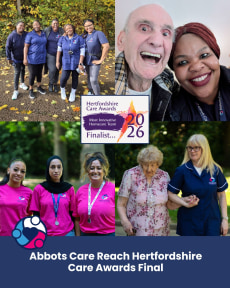
We've reached the final of the HCPA Care Awards 2026!
31-Mar-26
We've reached the final of the HCPA Care Awards 2026!